
Un informe técnico para compradores B2B que especifican ónix verde translúcido para proyectos de piedra retroiluminada: cubre pruebas con caja de luz, ingeniería LED, espesor como variable óptica, gestión de fragilidad en corte y envío, y arquitectura de costos. Proveedor de losas de ónix iraní Apexstone: más de 42 países desde 2002.
The Translucent Stone Problem Most Buyers Discover Too Late
Green Onyx is the only natural stone that glows. Hold a 10 mm (3/8 inch) slab up to a light source and the entire panel illuminates from within, revealing mineral veins that appear to float in three dimensions. This property — translucency — is what drives architects to specify onyx for feature walls, bar fronts, and reception desk surfaces in luxury hotels, restaurants, and high-end residences.
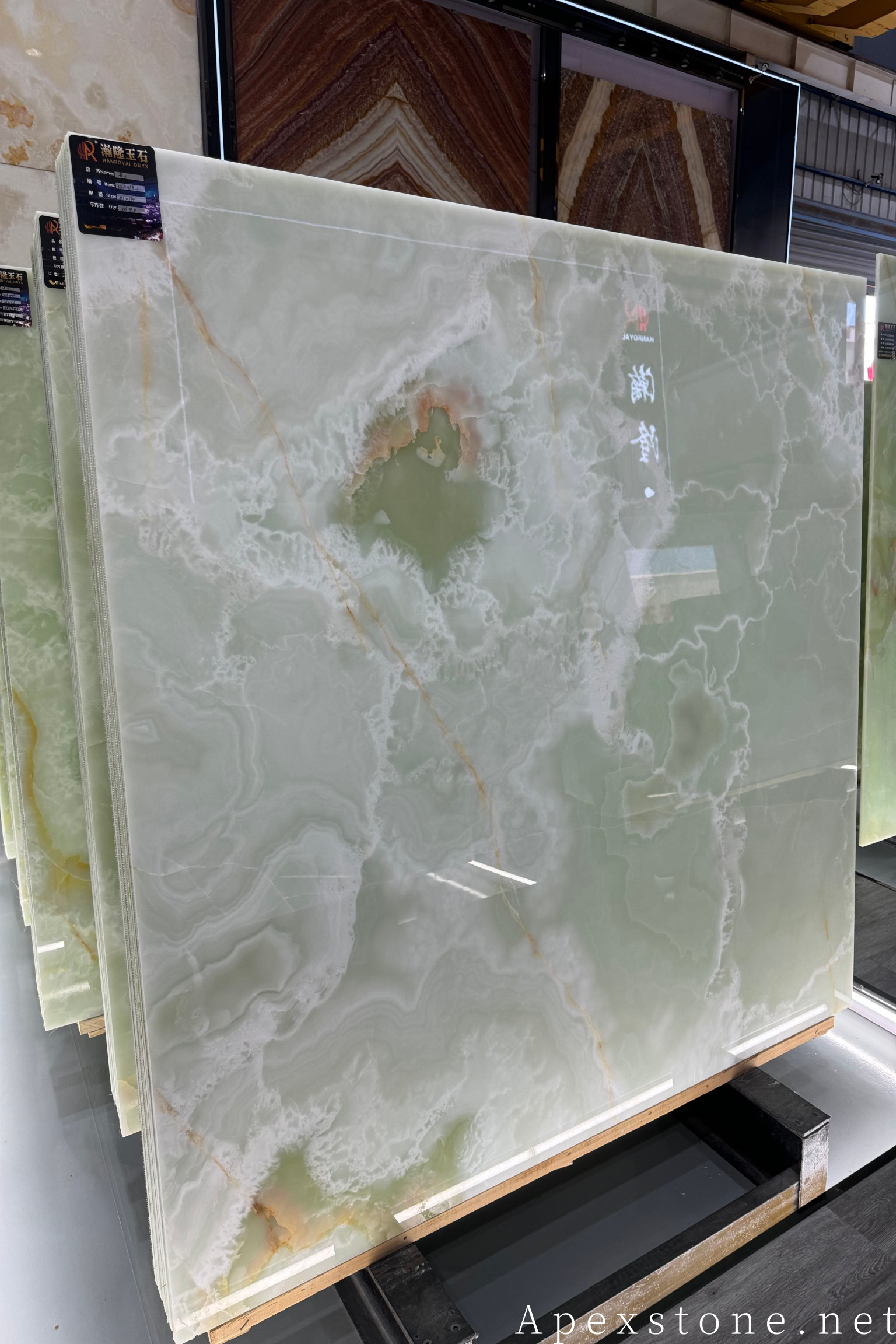
But translucency creates engineering problems that marble and granite buyers never encounter. Standard slab evaluation — colour, veining, structural soundness — covers only half the requirements. A buyer must also assess light transmission uniformity, plan LED panel placement behind the stone, calculate heat dissipation within a sealed cavity, and select thickness based on how much light should pass through. Get any of these wrong and the installation either glows unevenly with dark patches, or the LED heat yellows the stone over time.
This technical brief addresses the questions that B2B stone importers, hospitality procurement teams, and contracting firms should ask before committing to a Green Onyx programme — questions that go beyond the typical marble sourcing checklist.
Iranian Onyx Geology: Why These Quarries Produce the Best Translucent Green
Onyx forms differently from marble. While marble is metamorphic — limestone recrystallised under heat and pressure — onyx is a sedimentary deposit laid down by mineral-rich springs over thousands of years. Silica-rich water flows across a surface, cools, and deposits a microscopic layer of cryptocrystalline quartz. Layer upon layer, the stone builds up with each band recording a slightly different mineral composition.
The Iranian deposits in Kerman and Yazd provinces are geologically exceptional because the spring water carried high concentrations of copper and chromium compounds, producing the saturated green body colour — ranging from deep forest green to bright emerald — that makes Iranian onyx the benchmark for the global market. Pakistani and Afghan onyx from neighbouring geological zones produces similar green tones, but the Iranian material is widely regarded as having the most consistent colour saturation and the cleanest vein structure.
The white, gold, and brown bands running through the green body are mineral deposits — calcite, aragonite, and iron oxide — that formed during pauses in the silica deposition. These bands run through the full thickness of the stone. When backlit, they appear as luminous rivers of light against the translucent green background, creating the three-dimensional depth effect that no surface-applied pattern can replicate.
Apexstone sources onyx blocks directly from select Iranian quarry partners. Each block is inspected at the quarry face for colour saturation, vein continuity, fracture-free integrity, and — critically — translucency, before being approved for export to our Xiamen fabrication facility.
The Light Box Test: Verifying Translucency at the Factory
Before a slab is approved for a backlit programme, it must pass a translucency verification. There are two methods, and a serious supplier should perform both:
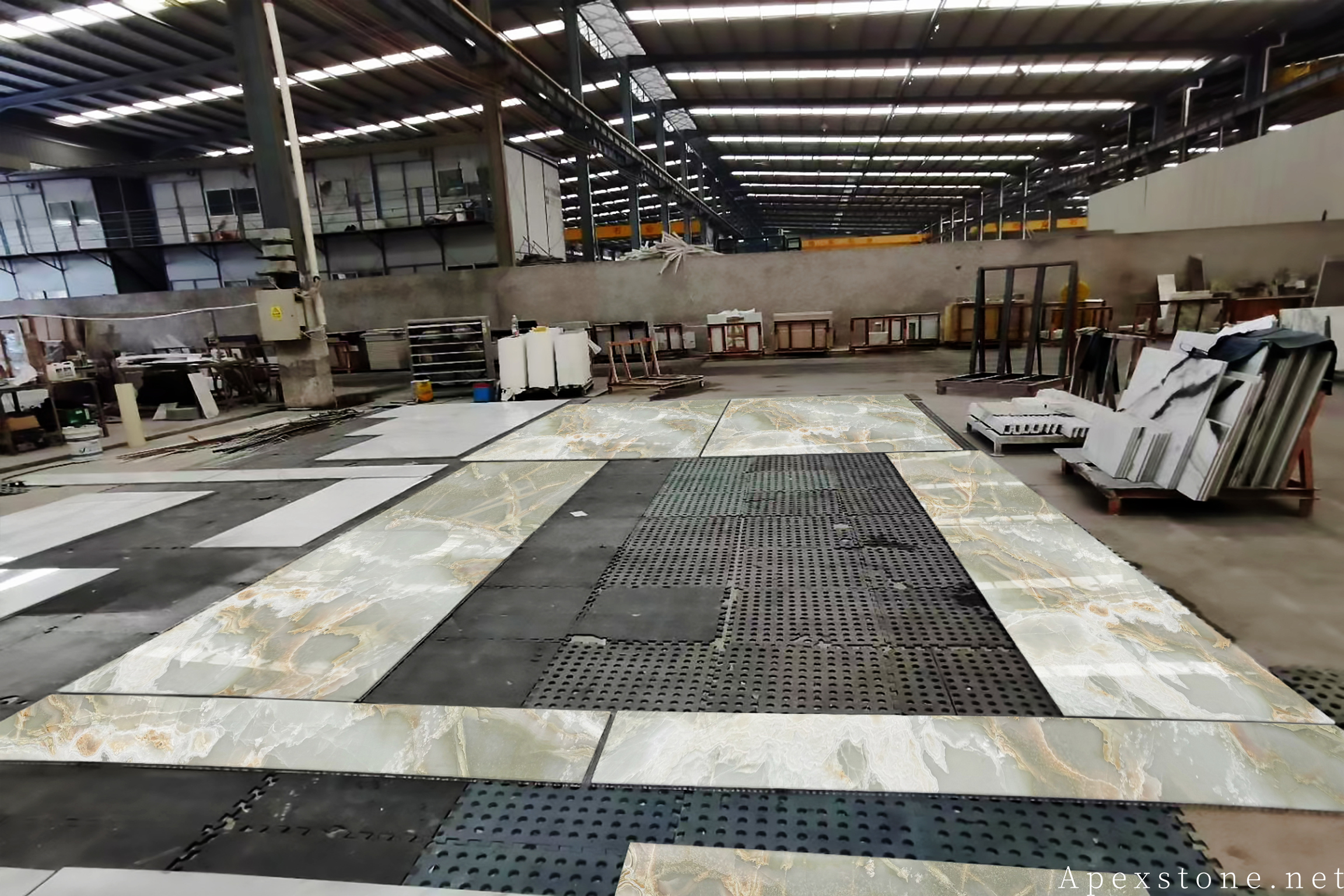
Method A — Light Box Test: The slab is placed flat on a light box with even, diffused illumination across the full surface. A high-quality translucent onyx shows uniform light transmission across the entire panel. Dark spots or opaque zones indicate dense mineral concentrations that will not transmit light — these areas will appear as dark patches in the final installation. Slabs failing this test are downgraded to non-backlit applications (wall cladding, mosaic tiles).
Method B — Flashlight Diffusion Test: A high-lumen LED flashlight is pressed against the back face of the slab. In premium-grade onyx, the light spreads outward in a soft, wide circle — 300 mm (12 inch) radius or more — indicating that the stone transmits light evenly through its crystalline structure. If the light remains a tight beam with minimal spread, the stone is too dense for backlighting at that thickness.
Apexstone performs both tests on every slab destined for a backlit programme. Slabs are graded and tagged: Backlit Premium (uniform transmission, no dark zones), Backlit Commercial (minor dark zones acceptable for non-critical areas), and Non-Backlit (suitable for cladding, mosaics, and tabletops where translucency is not required).
LED Integration Engineering: Wattage, Spacing, and Thermal Management
A backlit onyx wall is a lighting installation as much as a stone installation. The LED system behind the stone determines whether the final result is a luminous, even glow or a patchy field of hotspots and shadows. Three engineering parameters must be specified before the stone panels are fabricated:
LED Panel Spacing: Mount LED panels 50–80 mm (2–3 inch) behind the onyx surface. At 50 mm (2 inch), the light is brighter and more direct; at 80 mm (3 inch), the glow is softer and more diffused. The key principle: the distance between LED panels must be less than or equal to the distance from the LEDs to the stone surface. If panels are spaced wider than the cavity depth, dark bands will appear between them.
Colour Temperature Selection: The LED colour temperature dramatically changes how the onyx appears. Warm-white LEDs (2700–3000K) bring out the gold and brown mineral veins, producing a rich, amber-tinged glow. Neutral-white (3500–4000K) produces the most vivid green, making the stone appear to pulse with emerald light. Cool-white (5000K and above) washes out the warmth of the stone and is not recommended — it makes premium onyx look like tinted glass.
Thermal Management: LED panels generate heat, and onyx is sealed inside a cavity with limited ventilation. Specify low-heat LED modules with a surface temperature below 40°C (104°F) at continuous operation. Provide a minimum 20 mm (3/4 inch) ventilation gap between the LED array and the rear substrate. For installations in humid environments (spa areas, poolside bars), use IP67-rated waterproof LED modules. Always include a removable access panel — at least 300x300 mm (12x12 inch) — for LED maintenance and replacement. An LED module will fail before the stone does; if there is no access panel, the entire wall must be dismantled to replace a single component.
Thickness as a Light Control Tool
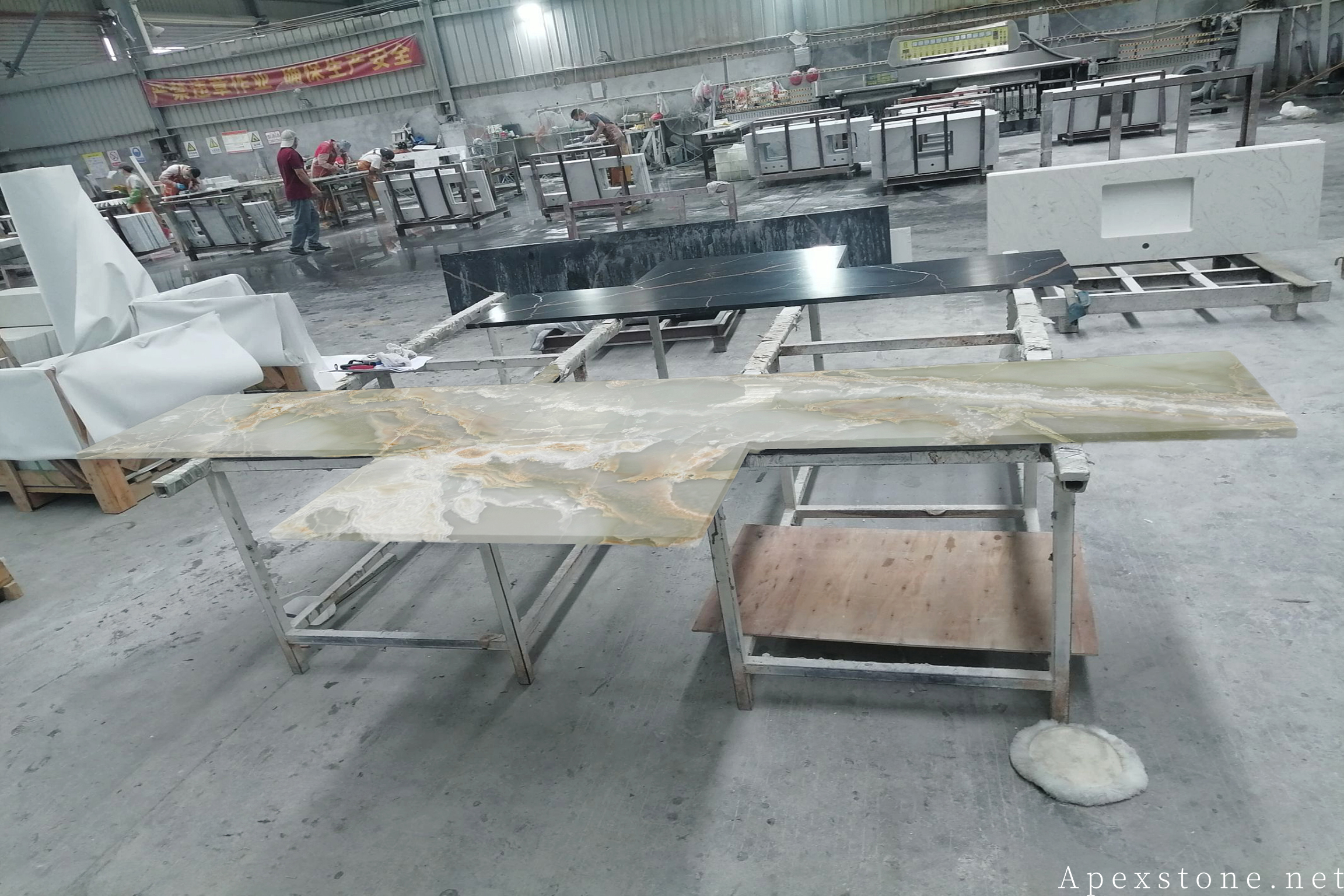
For most stones, thickness is a structural decision. For onyx, it is also an optical one. The thickness of the panel directly controls how much light passes through, and therefore how the stone glows:
| Panel Thickness | Light Transmission | Best Application |
|---|---|---|
| 10 mm (3/8 inch) | Maximum — stone appears to glow from within | Backlit feature walls where drama is the priority; mosaic tiles |
| 15 mm (5/8 inch) | High — softer, more even glow than 10 mm | Backlit feature walls in residential and hospitality settings — the sweet spot |
| 20 mm (3/4 inch) | Moderate — stone glows but with more body colour visible | Bar tops, reception counters, tabletops where structural strength matters |
| 30 mm (1-1/4 inch) | Low — minimal light passage; stone reads as solid green | Non-backlit countertops and tabletops; structural applications |
The 15 mm (5/8 inch) panel is the most versatile choice for backlit feature walls: it provides enough structural integrity for large-format installation (up to 3000x1800 mm / 118x71 inch slab size) while transmitting enough light for a warm, even glow. The 10 mm (3/8 inch) panel is dramatic but fragile — it is better suited to mosaic installations and small feature panels where the stone is fully supported by a backing substrate.
Fragility Management: Cutting, Handling, and Shipping Onyx vs Marble
Onyx is more brittle than marble. Its cryptocrystalline structure, while beautiful, makes it prone to fracture along vein lines — particularly where the mineral bands change composition abruptly. This fragility affects every stage of the supply chain:
Cutting: Onyx slabs are cut on CNC bridge saws with continuous-rim diamond blades and a high-volume water flow to prevent thermal shock. Feed speed is reduced by 30–40% compared to marble. For edge profiling, CNC routers use segmented diamond wheels at low RPM to avoid chipping at vein intersections. Every cut edge is inspected under raking light for micro-fractures before the panel moves to polishing.
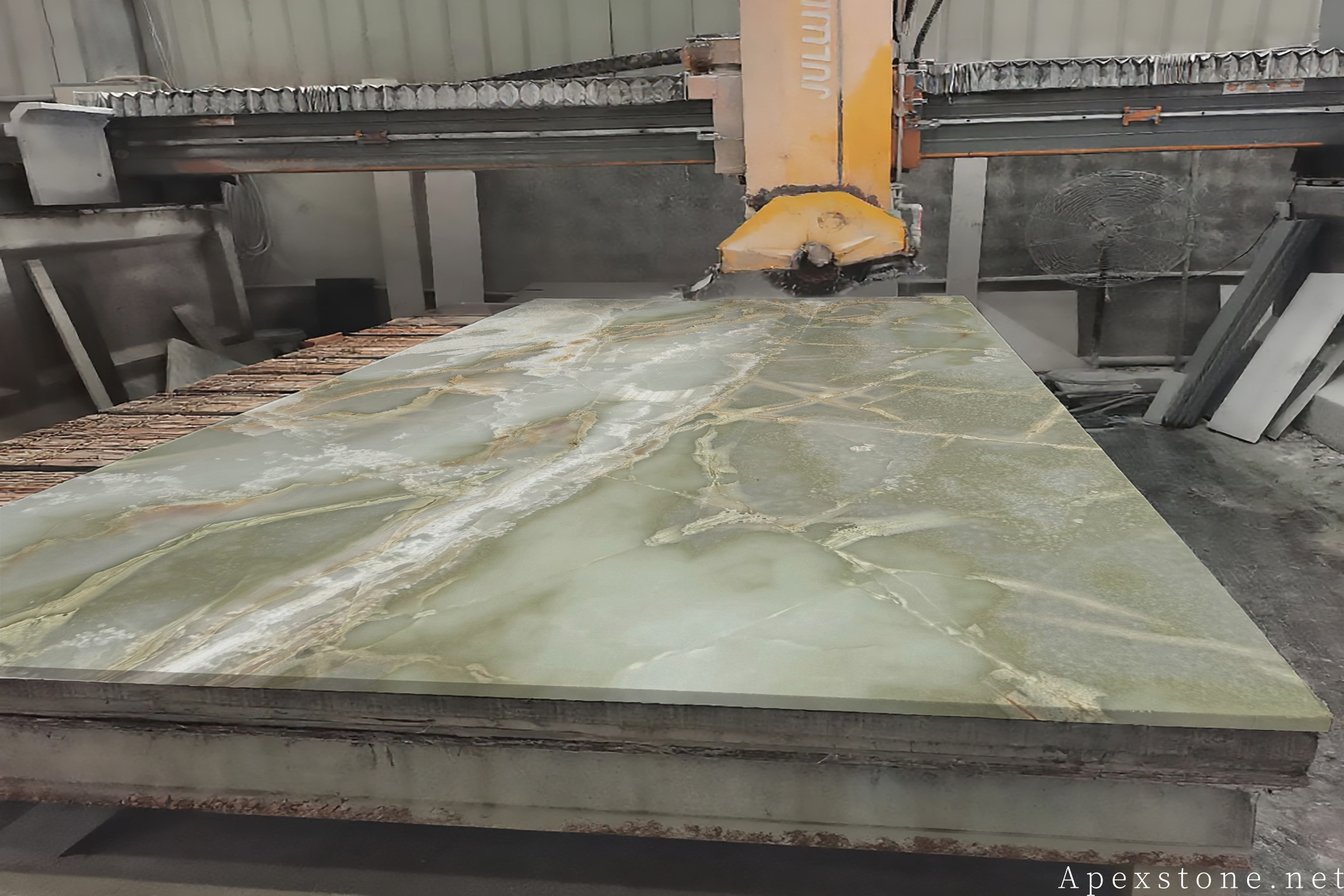
Handling: Finished onyx panels are handled by a minimum of two persons using vacuum suction lifters rated for natural stone. Panels are never lifted by the edge alone — the weight of the panel concentrated on a narrow edge can initiate a crack along a vein line. All handling surfaces are padded with closed-cell foam to prevent point-loading.
Shipping: Each onyx panel is individually wrapped in 5 mm closed-cell foam, separated by polyethylene sheets, and packed in wooden crates with timber bracing at every panel edge. Crates are loaded into containers with shock-absorbing rubber pads between crate and container floor. For LCL (less-than-container-load) shipments, crates are additionally wrapped in stretch film and strapped to pallets to prevent shifting during transshipment. Apexstone provides full crating photographs and loading documentation for every shipment.
Cost Architecture of a Backlit Onyx Wall
Green Onyx is a premium natural stone — significantly more expensive than marble, limestone, or granite. Understanding the cost structure helps B2B buyers budget accurately and avoid surprises:
- Slab grade: Backlit Premium grade (fracture-free, uniform translucency, vivid green) commands a 30–50% premium over Commercial grade. For visible feature walls, always specify Premium.
- Thickness premium: Thinner panels (10 mm / 3/8 inch) cost more per square metre than 20 mm (3/4 inch) panels because thinner cutting requires higher precision and carries a higher breakage rate during fabrication.
- Slab size: Large-format slabs (3000x1800 mm / 118x71 inch) minimise visible joints in a backlit wall but cost more per m². For walls wider than 3 m (118 inch), book-matched slab pairs from the same block ensure vein continuity across the seam.
- LED system: Budget separately for the LED panels, drivers, wiring, and access panel hardware. The LED system typically costs 15–25% of the total wall budget.
- Quantity: Wholesale B2B orders of 50 m² (538 ft²) or more receive quantity discounts. Single-slab or small-quantity orders carry a premium of 15–20%.
Contact Apexstone for a project-specific quotation including slab pricing, fabrication, crating, and shipping.
Project Checklist for Importers
Before placing a Green Onyx order, confirm the following with your supplier:
- Quarry origin verified (Iran — request quarry documentation if required for customs)
- Slab grade specified (Backlit Premium for feature walls; Commercial for cladding/mosaic)
- Light box test results provided (photograph or video of each slab on a light box)
- Thickness selected based on application (10 mm for max translucency; 15 mm for balanced performance; 20 mm for structural surfaces)
- LED system specified (colour temperature, wattage, IP rating, spacing, access panel location)
- Slab sequence and book-match layout confirmed for multi-panel walls
- Edge profile specified (eased, beveled, bullnose — or custom per CAD drawing)
- Crating and shipping terms confirmed (FOB Xiamen or DDP destination)
- Lead time confirmed (25–35 days from drawing approval for standard programmes)
Apexstone has supplied natural onyx to projects in 42 countries since 2002. Our Iranian Green Onyx slabs are sourced directly from select quarry partners, tested block-by-block for translucency, and processed in our Xiamen facility with precision cutting, calibrated thickness, and high-gloss polishing. We provide CAD pre-visualisation, custom panel sizing, LED integration drawings, and full logistics coordination for B2B importers.